Garden Ring Apartment, 52 m²
A 1962 brick building on a hill along the Garden Ring: three south-facing windows that a standard partitioned layout had never allowed to work as one.
Description
Beams as the Framework for Zoning
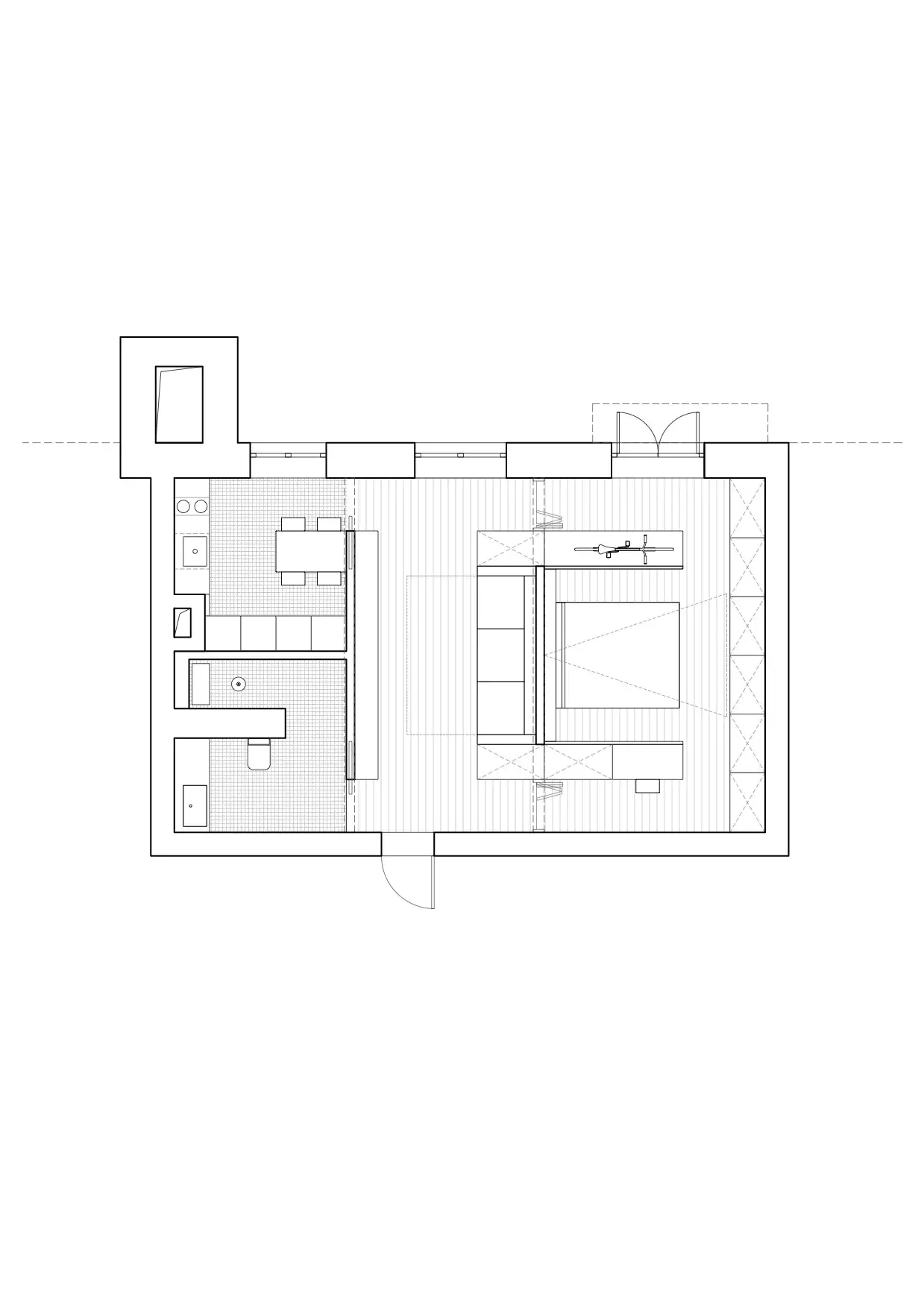
Two structural beams divide the plan into three longitudinal bands. The left band consolidates the entire wet zone: kitchen and bathroom. The stacks are gathered into a compact cluster along a single axis; the former corridor to the kitchen is eliminated — the entrance now opens directly into the kitchen area. The central band between the beams is occupied by the living room. The right band is given to the private bedroom.
Partitions are placed strictly along the beam lines: the structure is not concealed but made the visible logic of the plan. The standard practice of hiding load-bearing elements behind finishes is inverted here — the beams and columns set a rhythm that everything else follows.
The Furniture Perimeter Within the Central Band
In the living room, tall cabinets, shelving, and storage modules are arranged along the perimeter so that their upper edges meet the underside of the beams. This furniture perimeter forms a second layer of zoning within the central band. The bed is concealed inside the perimeter: surrounded by furniture partitions with transparent inserts, it is not visible from the living room. The sofa faces the window or the TV zone, with its back to the bedroom partition.
This device solves a problem that apartments of comparable area usually resolve through separate rooms: the bedroom feels secluded even though it is physically separated only by furniture and partial partitions.
Three Windows as a Continuous Band
Removing the partitions opened all three south-facing windows at once. Along the adjacent wall runs a five-metre storage cabinet. Around the central core, circulation routes allow movement between the windows — the choice of where to sit is determined by the position of the sun rather than by the designated function of the zone.
A gradient of privacy increases from the entry toward the right band; light and air move through the full depth of the plan without barriers. In late Soviet residential buildings this degree of openness was rarely achieved: standard series assumed isolated rooms as the norm rather than as one layout option among others.
Structural honesty here is not a declaration but a working method. The beams set the order, the furniture completes it, and the plan remains legible at every level — structural, functional, and in terms of light.